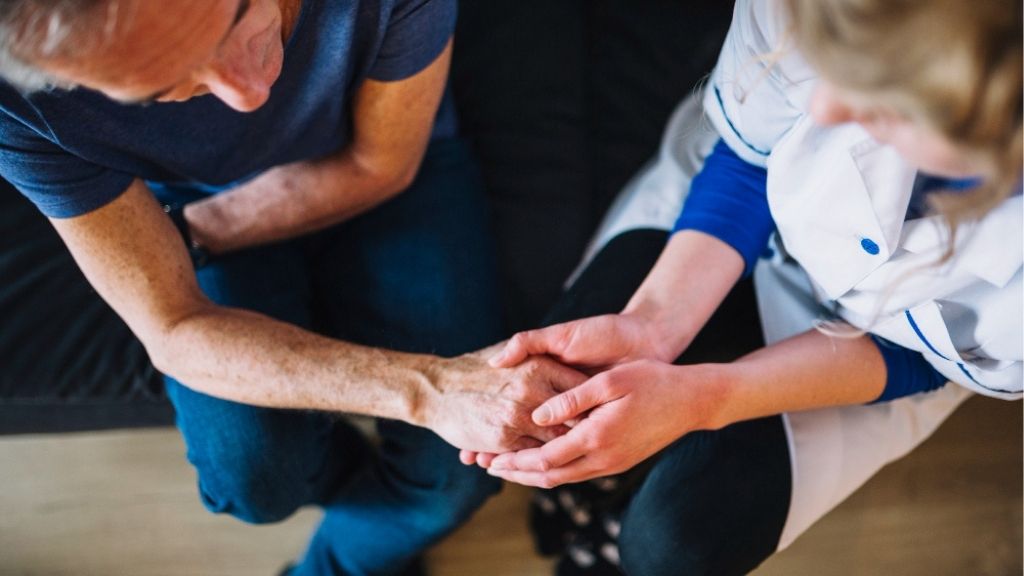
Alzheimer’s disease and other dementias gradually limit memory, orientation and the ability to carry out everyday tasks. Regular, well-planned activity, however, engages the skills a patient still has and helps maintain them for as long as possible.


What you’ll learn from this article
- which forms of occupational therapy the Memory Care program at Origin Centre Otwock includes,
- what art, cooking, music and movement sessions offer people with dementia,
- how therapy in the Snoezelen room works,
- why working in a small group affects patients’ mood and relationships.
The Memory Care program includes nine forms of occupational therapy. They fall into three groups: manual and practical activities, physical activity, and sessions based on sensory stimulation and contact with others. All of them share one goal: activating the patient through their strengths and preserving independence in everyday tasks for as long as possible. The individual activities differ in what they work on, because some engage mainly hand skills and movement, while others focus on memory, emotions or relationships.
Goals of occupational therapy for people with Alzheimer’s disease and other dementias
Dementia is progressive, so the aim of therapy is to maintain the skills a patient still has. In the Memory Care program, we build every session around the patient’s strengths and simple everyday tasks. A person who can still fold laundry or set the table receives tasks from exactly that area.
We approach memory training in an open and subtle way. Therapists weave exercises into ordinary activities, for example planning the next steps of a task or focusing attention on a single activity. As a result, participants do not feel tested, and for people with memory impairment, fear of making mistakes can lead to withdrawal from activities.
All of our work follows the principle of gerontological validation. It involves accepting the patient’s feelings and emotions and helping them stay oriented in their surroundings, without correcting or embarrassing them. Our staff also complete additional training in dementia care as part of the Origin Academy program. More details are available in the description of our Memory Care senior care program.
Creative work and everyday tasks as independence training
Art therapy at our centre includes paper crafts, embroidery and decorating objects. These activities engage manual dexterity, hand-eye coordination and attention. A finished piece also gives the patient a visible result of their own effort. The therapist matches the technique to each participant, since a task beyond a person’s abilities quickly leads to frustration.
Ergotherapy, or therapy through work, combines movement and activation exercises with tasks that have a real purpose. These include folding laundry and preparing a simple dessert or cake together. Purposeful activities give a person with dementia a sense of being needed, which supports a better mood and willingness to take part in further activities.
Cooking sessions serve a similar purpose. Preparing a simple dish requires planning the order of steps, measuring ingredients and staying focused for a while. Cognitive functions are therefore exercised through an activity familiar from the patient’s earlier life. The smell and taste of the food can also bring back memories of home.
Music and literature in working with memory and emotions
Music therapy in the Memory Care program includes group singing, listening to music and dance sessions. Familiar songs from youth can prompt a response even in people who find conversation difficult. The melody also sets the rhythm of movement while dancing, so these sessions combine emotional stimulation with physical activity. Further opportunities to dance come with live music at the special events we organise.
Bibliotherapy involves listening to excerpts from books and poems, reading themed publications together and discussing the text. Reading aloud engages hearing and attention in particular. The conversation afterwards, in turn, exercises putting thoughts into words and recalling associations. We choose texts to suit participants’ interests and current abilities.
Outdoor movement and exercise adapted to each person’s fitness
One of the main goals of the program is to preserve seniors’ mobility for as long as possible. Group exercise sessions focus on general fitness, and therapists adjust their intensity to residents’ abilities. Exercises often take place in a circle, using balls. Regular, well-matched movement supports physical fitness and may also reduce restlessness.
Silvotherapy is therapy through contact with nature. Origin Centre Otwock is surrounded by a private pine park and woodland with paved paths. Patients walk along them, always under the supervision of caregivers. The firm surface matters in practice, as it makes walking easier for people with balance problems. A walk among greenery combines moderate effort with calm, and observing the weather and seasons can support orientation in time.
How the Snoezelen room works and who it helps
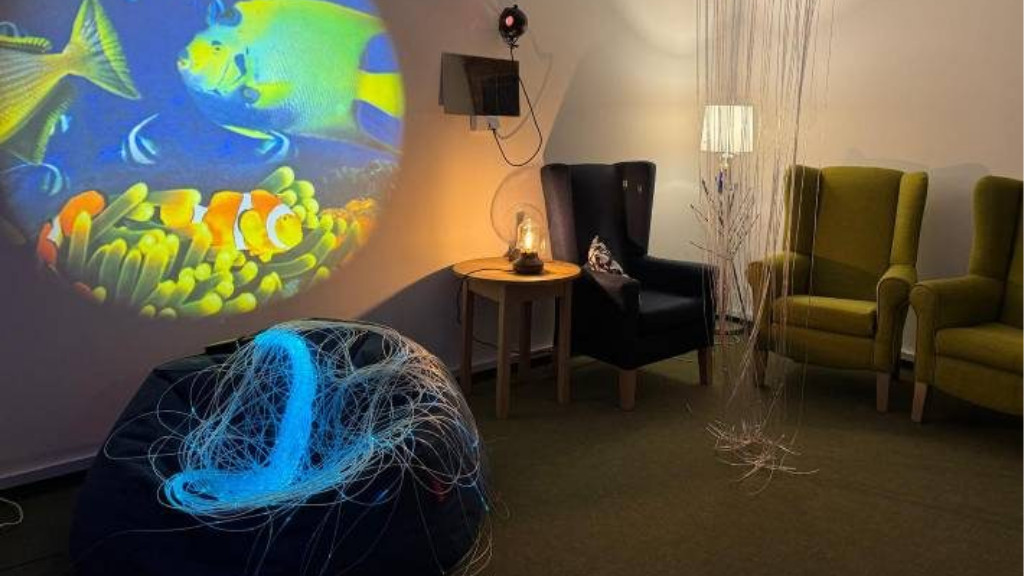
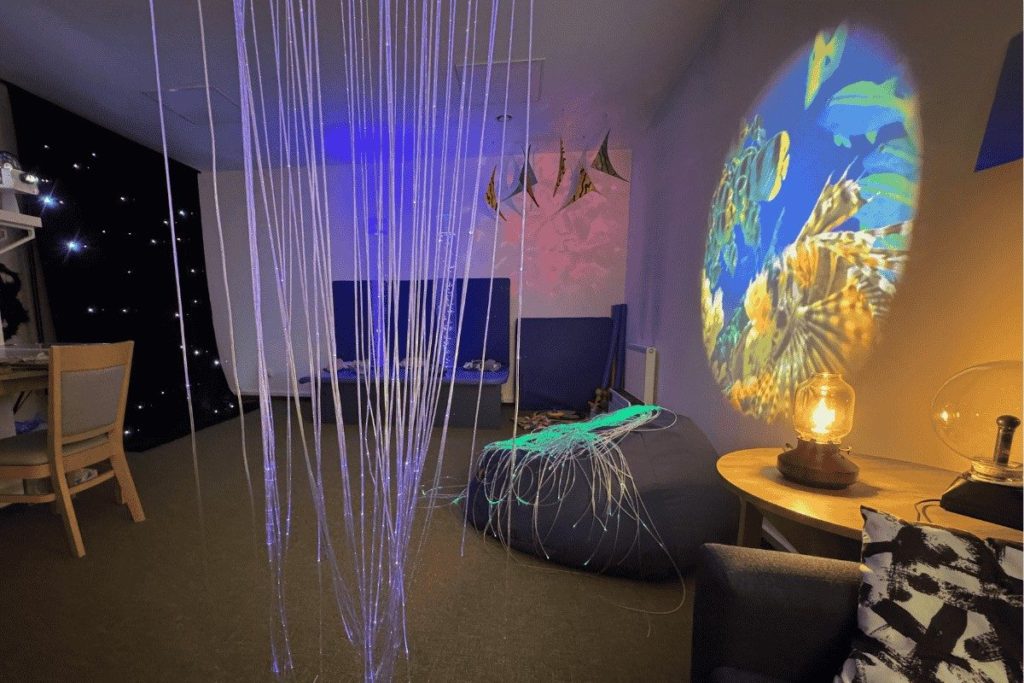
The Snoezelen room, also known as the Multi-Sensory Room, is a space designed for safe and controlled sensory stimulation. The therapist regulates the intensity of sensory input and adjusts it to the patient’s responses. The main purpose of each session is therefore to ease tension, stress and anxiety.
For people with Alzheimer’s disease and other cognitive impairments, a calm, predictable environment makes relaxation easier and increases their sense of safety. Lower frustration and agitation may, in turn, reduce aggressive and self-harming behaviour. Lower stress levels after a session also affect sleep quality.
Sessions additionally support non-verbal communication. A patient who struggles to express needs in words may respond to a stimulus with a gesture, facial expression or change in posture. Such a response tells the therapist how the person is feeling, particularly at more advanced stages of the disease.
Sociotherapy and life in a small community on the ward
Therapy through contact with a group, known as sociotherapy, encourages shared activities and helps build new relationships. This matters greatly for people who have withdrawn from social life because of their illness. Memory Care wards form small communities of around 10–13 people, grouped by a similar stage of the disease. This makes it easier to run sessions at a pace that suits every participant.
Group life also includes events beyond the therapy schedule. We celebrate residents’ birthdays together and organise special occasions, including performances by partner schools and kindergartens. Contact with children brings new stimuli and topics of conversation into everyday life on the ward. In line with the principle of validation, every participant can speak up and have a say in the life of the group, which strengthens their sense of still being needed.
Frequently asked questions
Can a person with advanced dementia take part in occupational therapy at a care centre?
Yes, because we match the form and intensity of activities to the patient’s current abilities. Wards bring together people at a similar stage of the disease, so the pace of work suits the participants. When verbal communication is significantly limited, sessions in the Snoezelen room, based on sensory stimulation, often prove particularly helpful.
What does a patient’s daily schedule look like in the Memory Care program, and where do therapy sessions fit in?
Therapy sessions are a regular part of the daily schedule, alongside meals, help with everyday tasks and walks. A clear, consistent daily rhythm supports a sense of security in people with dementia. The specific choice of activities follows from an individual therapy plan that takes into account the patient’s past habits and current needs.
Can occupational therapy stop the progression of Alzheimer’s disease?
Occupational therapy does not treat the underlying cause of the disease. Its role is to maintain retained skills, support independence and improve the patient’s wellbeing. Diagnosis and treatment are handled by specialists, including a neurologist and a neuropsychologist.
Does the family receive information about how their relative is doing in the dementia care program?
The Memory Care program includes regular consultations with medical specialists and periodic diagnostic reports. These reports document changes in the patient’s health and functioning. Families can discuss the results and therapy progress directly with the care team.
How can I enrol a relative with dementia in the Memory Care program in Otwock?
Admission is based on a review of medical records, an assessment of the patient’s current health and an interview with the patient and their family. The medical team makes a decision within a few days of receiving complete documentation. The first step is to get in touch through the enquiry form.